
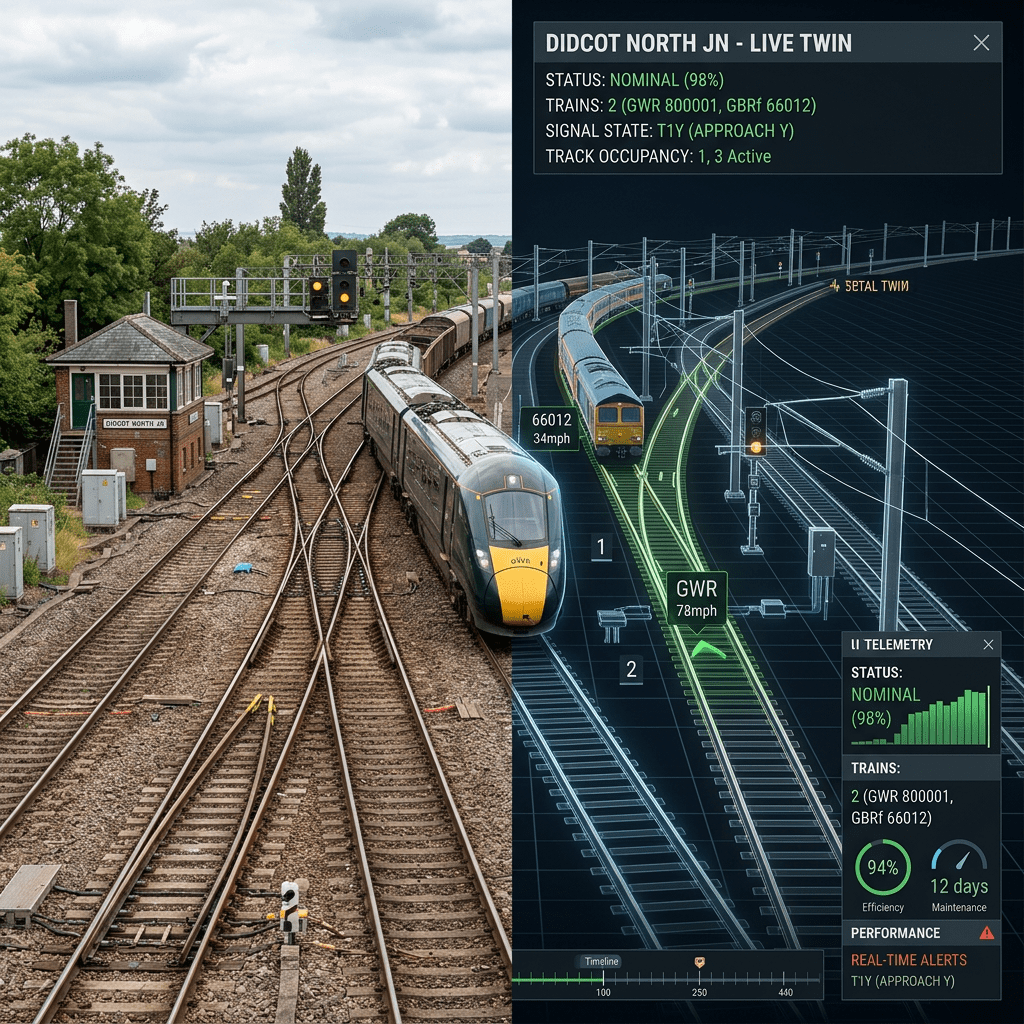
Rail keeps talking about AI. But until it builds trustworthy digital twins and live operational models, most of that AI will remain decorative rather than transformational.
Rail’s AI Problem Is Not Really an AI Problem
Every industry says it is “doing AI” now. Rail says it. Aviation says it. Retail says it. Your dentist probably says it while quietly trying to sell you a more expensive toothbrush. But there is a difference between sprinkling AI on top of old processes and actually changing how a system works. In rail, that difference matters. Because rail is not a recommendation engine, a chat assistant, or a clever dashboard for middle managers. It is a tightly coupled, safety-critical, infrastructure-bound system where small uncertainties can turn into very large delays very quickly. If the industry wants AI to matter operationally — not just in PowerPoint — it needs something more fundamental first: digital twins that represent the railway well enough, fast enough, and safely enough to support decisions in real time. Europe’s Rail is already pushing digital twins and capacity simulation methods to evaluate ETCS, Traffic Management Systems, Automatic Train Operation and related innovations, which shows the sector is heading in this direction rather than me simply shouting at clouds.
That sounds abstract, so let’s ground it in something wonderfully mundane: a delayed train near Paddington, a failed set of points, or a dodgy track circuit. Suddenly signals sit at red, platforms clog up, crews and stock are in the wrong place, and passengers start hearing the sort of announcements that make people instinctively open Google Maps to check whether walking home is an option. Network Rail’s explanation of track circuits is actually refreshingly honest: these systems are designed to prove the absence of a train, and if they fail, they often fail safe by behaving as if a train is present. That is exactly what you want from safety engineering. It is also exactly why the railway can feel brittle. The current control philosophy is optimised to avoid unsafe states, not to recover gracefully from uncertain ones.
Why Aviation Feels More Dynamic
This is why aviation is such a useful comparison. Not because trains are planes — clearly they are worse at flying — but because aviation already solved a version of the problem rail is now circling around. The FAA describes ADS-B as the preferred surveillance method for air traffic control in the US, improving safety and efficiency through real-time precision and shared situational awareness. In aviation, controllers do not simply know whether a block is occupied. They know where aircraft are, how fast they are moving, and what conflicts may emerge next. That richer state awareness enables not just monitoring, but prediction and tactical intervention. In other words, aviation already has the kind of live, shared operational picture that AI needs in order to be genuinely useful.
Rail, by contrast, still often behaves like a world built around binary truth statements. Is the section occupied? Is the route set? Is the signal cleared? These questions are not wrong; they are foundational. But they are not enough for higher-order optimisation. AI thrives on rich state, strong telemetry, and fast feedback loops. If your operational model only knows “occupied / not occupied” and your exception handling is essentially “stop and investigate,” then your AI ambitions are going to be limited to prediction around the edges: maybe some maintenance forecasting, maybe some demand modelling, maybe a nicely coloured disruption dashboard that tells you the obvious five minutes faster than before. Useful, yes. Transformational, no.
What a Real Railway Digital Twin Actually Is
This is where digital twins stop being a bit of smart-infrastructure theatre and become strategically important. A proper railway digital twin is not just a 3D model with shiny trains gliding around a screen to impress executives. It is a live operational representation of the physical network, its assets, its rolling stock, its timetable, its constraints, and its current state. Europe’s Rail defines digital twins as virtual representations of physical assets or systems with which data can be exchanged bidirectionally in order to observe, analyse, simulate and optimise performance. In parallel, rail research is already showing how digital twin architectures can ingest real-time train movements and timetable data to model disruption impacts and operational scenarios. That is the crucial bit: not visualisation for the sake of it, but a platform for analysis, simulation and optimisation.
Now add AI to that. Suddenly the conversation becomes much more interesting. Without a digital twin, AI in rail is mostly retrospective, localised, or advisory in a narrow sense. You can train models to predict failure probabilities on points motors. You can estimate passenger crowding. You can flag likely knock-on delays. All useful. But once you have a live digital twin, AI can move up a level. It can test alternative dispatching choices, identify likely conflict chains before they materialise, propose optimal platforming strategies under disruption, estimate passenger impact in parallel with network impact, and continuously ask a question the railway desperately needs answered faster:“If this is happening now, what is the least bad next move?” That kind of AI is only possible when the data model is rich enough to simulate consequences rather than merely classify symptoms.
Why AI Without a Digital Twin Stays Superficial
There is already evidence of the sector edging toward this. Europe’s Rail has published work on capacity simulation methods for new digital train operations, including ETCS, ATO, TMS and next-generation braking, across multiple simulation packages and scenarios. That matters because it shows the industry is not just digitising the current railway, but trying to understand how a more dynamic one behaves. The UK and wider European environments are also seeing route and corridor twins used to improve planning, construction, maintenance and performance analysis. Network Rail’s Transpennine Route Upgrade used a route-wide digital twin approach to support safer, more efficient design and handover across a very complex programme. HS1 and partners have also explored an AI-based enterprise digital twin originally conceived in aerospace, specifically to improve operations, inspection, maintenance and renewals planning. These are not trivial pilots; they are signs of a sector gradually building the information layer AI will require.
The reason aviation is ahead is not simply because it is “more innovative.” It is because it built the right control abstractions earlier. Aircraft operate within a system that already assumes continuous surveillance, central coordination, dynamic conflict management and probabilistic planning. That makes it much easier to insert AI into the decision-support stack. Airport and airspace systems already use simulation tools to explore slot allocation, gate use, traffic conflicts and capacity scenarios. Research on airport slot allocation routinely validates scheduling strategies with fast-time simulation to understand how capacity changes affect conflicts and delay. In plain English, aviation has spent years treating the operating environment as something modelled, simulated and actively managed, not merely signalled and reacted to.
ETCS, Traffic Management and the Path to Smarter Rail
Rail could move further in that direction, but let’s not get carried away and pretend the problem is simply one of institutional laziness. Rail has harder coupling in some respects. A train cannot climb to a higher altitude to create spacing. It cannot vector around a blockage. It often cannot even overtake without pre-existing infrastructure that was designed for exactly that purpose. The network is one-dimensional in a way airspace is not. ETCS helps by enabling continuous supervision of train movement and, depending on implementation, reducing reliance on traditional lineside signalling. ERTMS is explicitly positioned by European institutions and industry as a route to higher safety, interoperability and greater capacity on existing infrastructure. But even with ETCS, the physical railway remains less flexible than the sky. That means AI in rail will never be about wild autonomy. It will be about making better decisions sooner inside hard constraints.
That distinction is important because it cuts through a lot of nonsense. The worst AI thinking in infrastructure tends to oscillate between two equally unhelpful extremes. One extreme says, “AI will run everything.” The other says, “Because safety matters, AI can never do anything important.” Both are lazy. The real answer is that AI becomes useful when paired with strong operational context, well-defined guard rails, and a human/system control model that knows what decisions are advisory, which are optimised recommendations, and which remain strictly deterministic. A digital twin gives you the state model. Simulation gives you the ability to explore alternative futures. Optimisation gives you candidate actions. And governance tells you which of those actions can actually be adopted. That stack is the real story — not some magical “AI dispatcher” replacing signallers with a neural network wearing a high-vis vest.
What a Good Control Room Could Look Like
So what would good look like? Imagine a control room that still uses proven signalling and safe movement authorities, but is wrapped in a live digital twin that continuously ingests train positions, infrastructure faults, platform occupancy, crew and stock constraints, passenger demand proxies and timetable intent. Now layer AI on top — not to overrule safety logic, but to simulate forward states every few seconds. The system spots that a points failure at one junction will, within twelve minutes, trap two inbound services, overload one platform group, break a crew diagram, and create a missed turnback that cascades for ninety minutes. Instead of waiting for that chaos to become real, it proposes three options, ranked by network punctuality, passenger impact, or operator priority. That is not sci-fi. It is a plausible extension of digital twin, traffic management and optimisation capabilities the sector is already developing.
There is a deep lesson here beyond rail. AI is only as useful as the operational truth layer underneath it. If the underlying system is fragmented, stale, and blind to its own state, AI mostly generates better-looking uncertainty. If the underlying system is instrumented, modelled and continuously reconciled with reality, AI starts to generate leverage. That applies just as much to airlines, engineering supply chains and airports as it does to rail. In fact, one reason aviation has been able to absorb more dynamic decision support is that its operational model already assumes shared situational awareness as a first-class capability. Rail’s opportunity is not to imitate aviation blindly, but to adopt the same architectural principle: rich, trusted, continuously updated state is the prerequisite for intelligent control.
Trust, Safety and the Limits of Automation
The other reason this matters is cost. Rail is expensive partly because it is infrastructure-heavy and safety-critical, but also because failures often trigger blunt operational responses. When the control model cannot degrade gracefully, disruption becomes costly. Digital twins and AI will not repeal physics, conjure new tracks out of thin air, or make flat junctions disappear. But they can help the industry use what it already has more intelligently. Europe’s Rail explicitly links digital twins to simulation, optimisation and data-driven decision-making aimed at reducing failures, lowering costs and improving quality. That is the most compelling business case for AI in rail: not “because AI is trendy,” but because a smarter operational model can reduce wasted time, wasted capacity and overly reactive interventions.
The final challenge is trust. In safety-critical sectors, trust is not built by slogans. It is built by bounded use cases, evidence, validation, explainability and progressive operational adoption. That means the first valuable uses of AI in rail will likely sit in recommendation, forecasting and scenario comparison, rather than direct automatic control of movements. Quite right too. Let AI earn its keep by being consistently useful, auditable and correct in a constrained problem space. Let the digital twin mature into a reliable operational substrate. Then, over time, more sophisticated forms of automation can sit on that foundation. This is exactly how serious industries evolve: not by replacing the core instantly, but by proving the next layer until it becomes normal.
The Real Lesson from Aviation
So yes, rail should absolutely talk about AI — but only if it is willing to talk about digital twins, live operational models, simulation fidelity, telemetry quality, control boundaries and trust. Otherwise it risks doing what too many industries do: bolting clever analytics onto systems that are still fundamentally blind, brittle and reactive. Aviation’s lesson is not “buy more AI.” It is “build the shared operational picture that makes intelligence usable.” Rail’s air traffic control moment will arrive when it stops asking whether AI can optimise the railway in the abstract and starts building the digital twin that allows the railway to understand itself properly in motion. When that happens, AI stops being decoration and starts becoming operational capability. [metrorailnews.in], [neuralnatter.blog], [ertms.be]
AI does not transform rail by being clever. It transforms rail by being connected to a truthful, live, operational model of the railway. That model is the digital twin. Everything else is garnish. [neuralnatter.blog], [ecfr.gov]
 Neural Natter